Nathan's Public Records Guide
Who am I and what is this?
This is a guide to making requests under the Massachusetts Public Records Law. The intended audience is newbies. No experience required 😆
This guide is written by me, Nathan. I am not a lawyer. I am not an expert. I am an amateur who has learned some things after making a few hundred of these requests.
What is the Massachusetts Public Records Law?
The Public Records Law is the Massachusetts equivalent to the federal Freedom of Information Act. Under this law, you may request records (documents, emails, etc.) from state agencies, municipalities, and other Massachusetts governmental entities.
Any record created by the government is by default public and may be requested under the law.
Some quick facts about the law
- The law does not apply to the legislature, the courts, or the governor's office (there is a ballot question to include some of these)
- The law does apply to municipalities (e.g. Boston and Gosnold), state agencies (e.g. State Police), and quasi-governmental entities (e.g. Massport)
- The government is required to produce a response to your request within 10 business days.
- The government may charge a fee based on the time required to produce a response.
- State agencies may not charge for the first four hours of time spent producing a response.
- Municipalities with a population greater than 20,000 may not charge for the first two hours.
- You are not required to provide your name when making a request. You can make your request anonymously using a pseudonym.
- The best resource for learning about the law is A Guide to the Massachusetts Public Records Law
Example Request
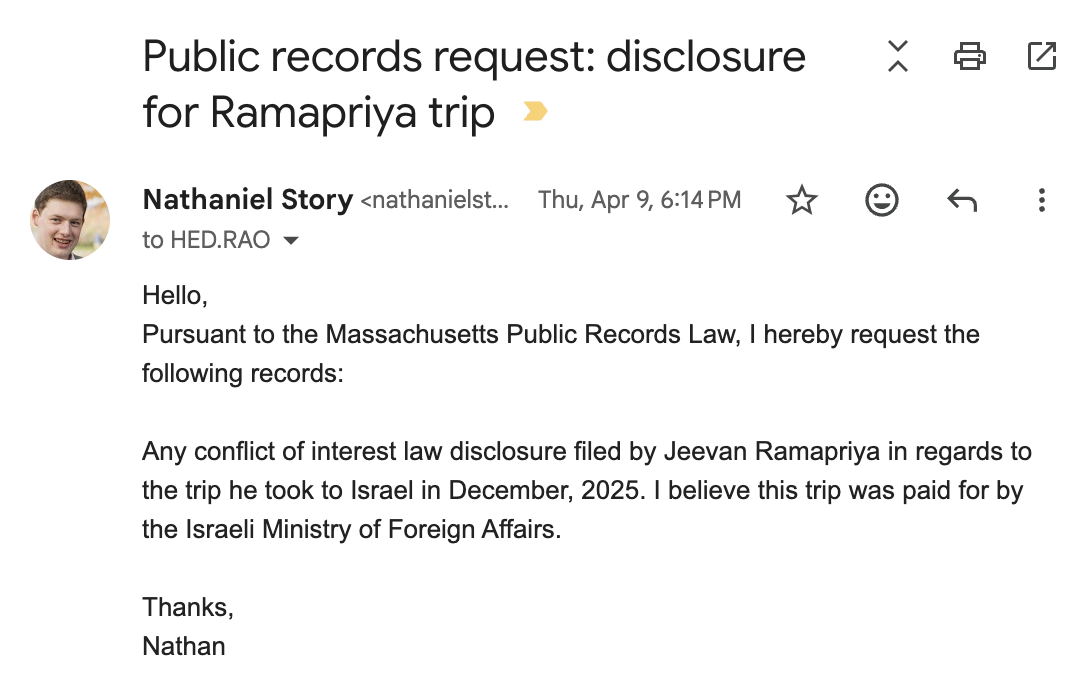
A request under the Public Records Law is just an email. You will see different people use different boilerplates. I keep it simple:
Pursuant to the Massachusetts Public Records Law, I hereby request the following records …
I sent this email to the Records Access Officer (RAO) of the Executive Office of Economic Development (EOED), because Jeevan Ramapriya works under the EOED. Like most state agencies, EOED has a helpful page where they provide the address of their RAO.
Step by step to Making a Request
- Identify the records you want and the agency that holds those records.
- Find the contact for the Records Access Officer (RAO). This will be posted somewhere on the agency's website (some agencies have a portal where you can submit your request)
- Send an email to the RAO requesting the records
Exemptions
The RAO may redact information that falls under one of the exemptions to the Public Records Law.
When redacting or otherwise withholding information, the RAO must cite a specific exemption.
See Exemptions to the Public Records Law for the full list of exemptions.
The most common exemption you will see in practice is Exemption (c). This exempts "... data relating to a specifically named individual, the disclosure of which may constitute an unwarranted invasion of personal privacy ..."
A common issue you may experience is an RAO wrongly applying exemptions, and withholding information that ought to be public. If you experience this, file an appeal.
Does this cost money?
You will almost never need to pay for a request.
If you are making your request to a state agency or quasi-governmental entity, the first four hours of time required to compile and redact your records is free. Agencies may charge for time beyond that up to $25/hour (see Fees in the Public Records Guide)
One important note: an agency may only charge a fee if they provide a fee estimate within 10 business days of receiving your request. If the agency fails to respond within 10 business days, they have forfeited their right to charge you a fee.
What now?
You sent your request, and you've waited ten business days. What do you do now?
If the RAO responded with the records, and you are satisfied, reply to them and say "Thank you!"
If the RAO hasn't responded, send them a follow up email e.g. "What is the status of this request?" Always wait until the 11th business day or later to send the follow up. This is after they can no longer charge you a fee.
If the RAO provided a fee estimate, you can either pay the amount requested, appeal the estimate, or narrow the scope of the request.
If the RAO hasn't responded after repeated follow ups, or they provided an unsatisfactory response, you can appeal the request.
Appeals
The Supervisor of Records under the Secretary of the Commonwealth of Massachusetts is responsible for appeals under the Public Records Law.
Forward the email chain to [email protected] and include a brief explanation of the problem. This will start the appeals process.
More Examples
Read other people's requests. Learn how to phrase your own requests, and learn what records are available:
- Town of Brookline / butcherie emails example of an email search submitted to the Town of Brookline via their online portal
- Boston Police Department Internal Affairs Compliment and Complaint police internal affairs files are public records
- Traffic Citations 2002 - 2021 (Massachusetts Department of Transportation (MassDOT))
Resources
- A Guide to the Massachusetts Public Records Law — this is the guide from the Secretary of the Commonwealth. Includes the full list of exemptions.
- All Requests - MuckRock — search and study requests submitted by other people. MuckRock is an amazing resource.